Trusted by industry leaders worldwide

TATA Power logo.
Adani logo with gradient color from blue to purple to red.
NPCIL logo featuring an atomic structure above the text 'Nuclear Power Corporation of India Ltd' on a blue circular background.
TATA Power logo.
Adani logo with gradient color from blue to purple to red.
NPCIL logo featuring an atomic structure above the text 'Nuclear Power Corporation of India Ltd' on a blue circular background.

Our path to next-generation nuclear intelligence

First Milestone

Simulate, train, and model reality

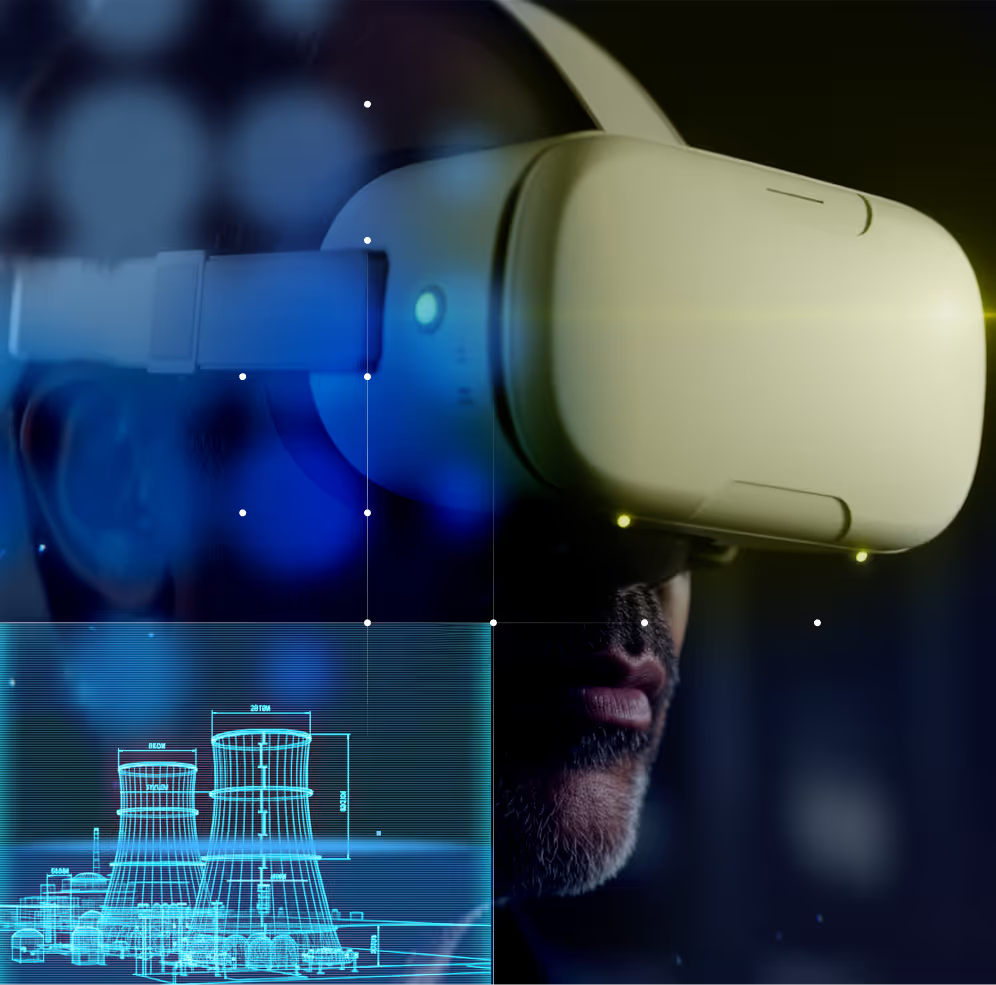
We begin with digital twins and immersive training — creating a virtual nuclear ecosystem where ideas can be tested, stressed, and perfected.
Man wearing virtual reality headset with holographic blueprint of industrial cooling towers in front.
Next Step

Improve through iteration and intelligence

AI copilots and continuous simulation data drive systematic improvements — refining designs, enhancing operating procedures, and reducing uncertainty at every layer of the system.
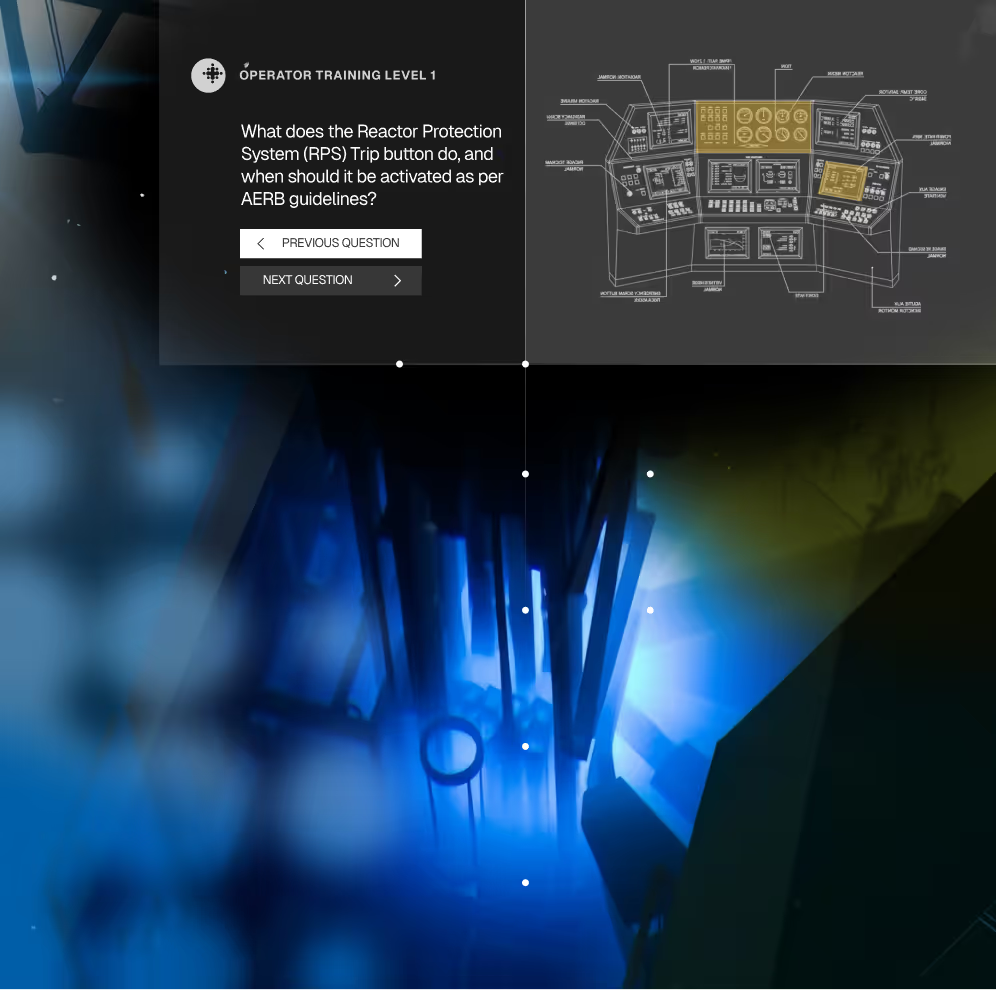
Operator training interface asking about the Reactor Protection System (RPS) trip button, alongside a schematic control panel layout with highlighted sections and a blue-toned image of reactor components.
Final Step

Build the future reactor

With validated digital models, evolved designs, and an AI-enhanced workforce, the final step is to design, construct, and operate modular nuclear reactors engineered for safety, efficiency, and scalability.
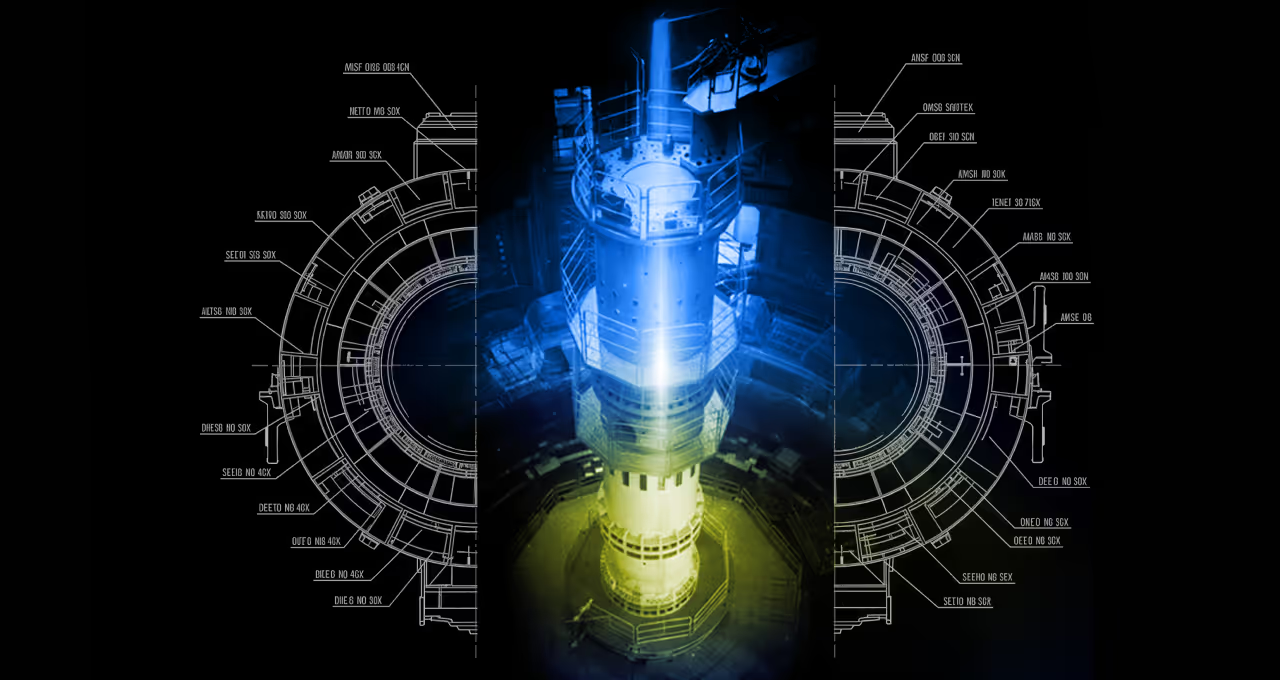
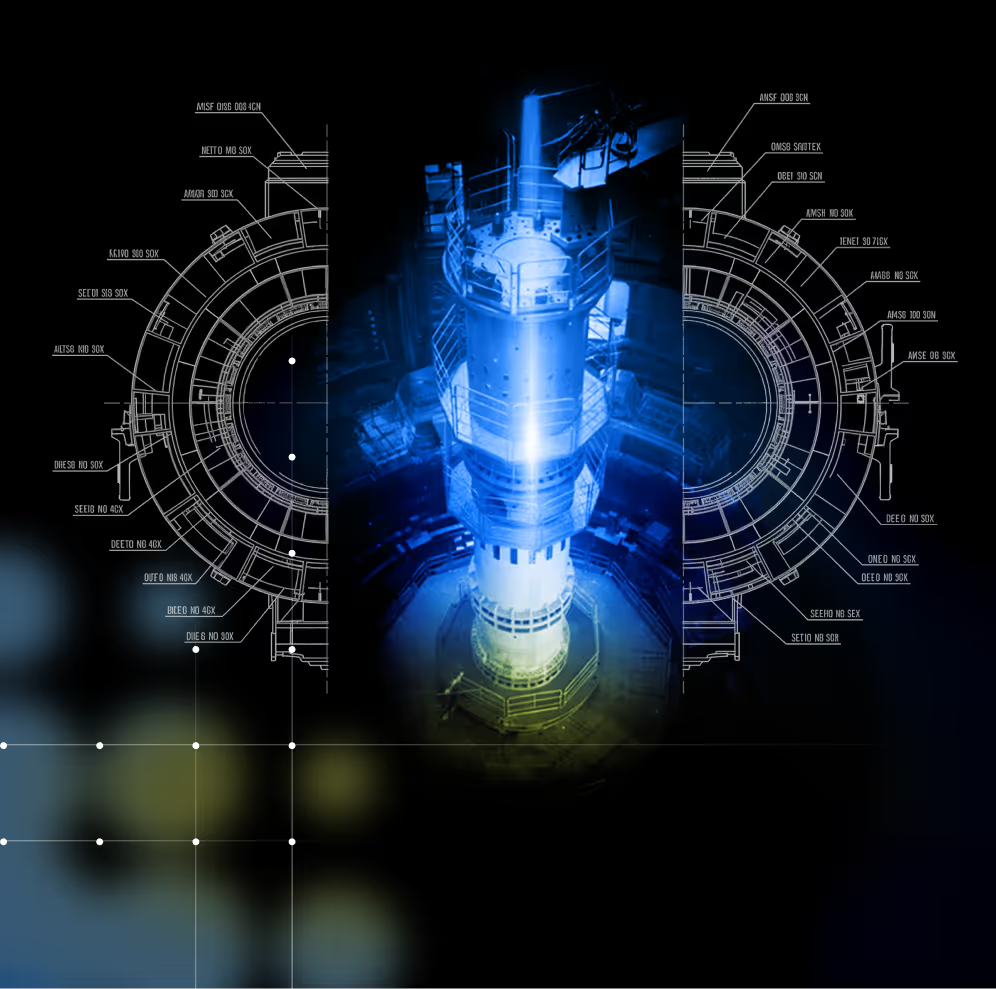
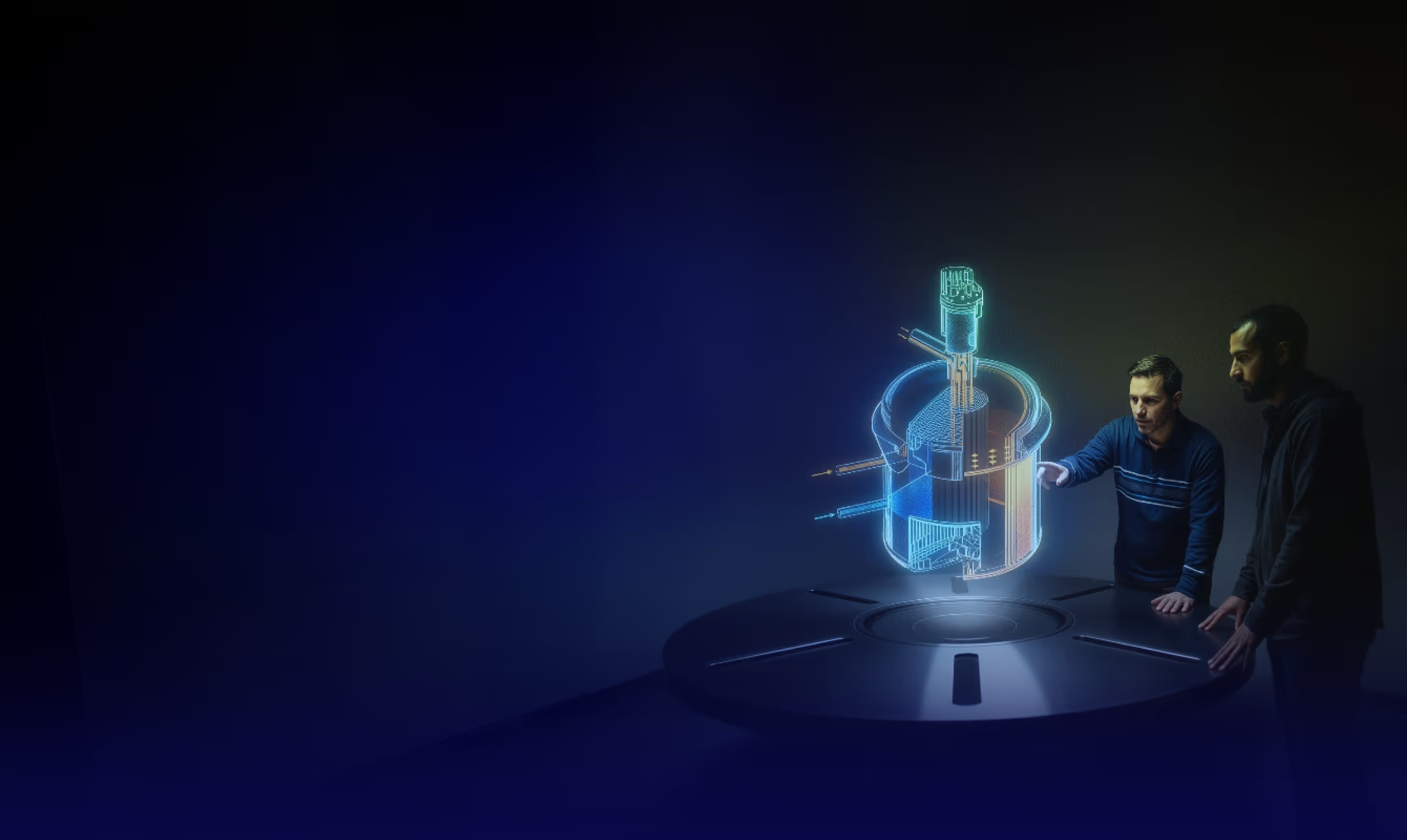
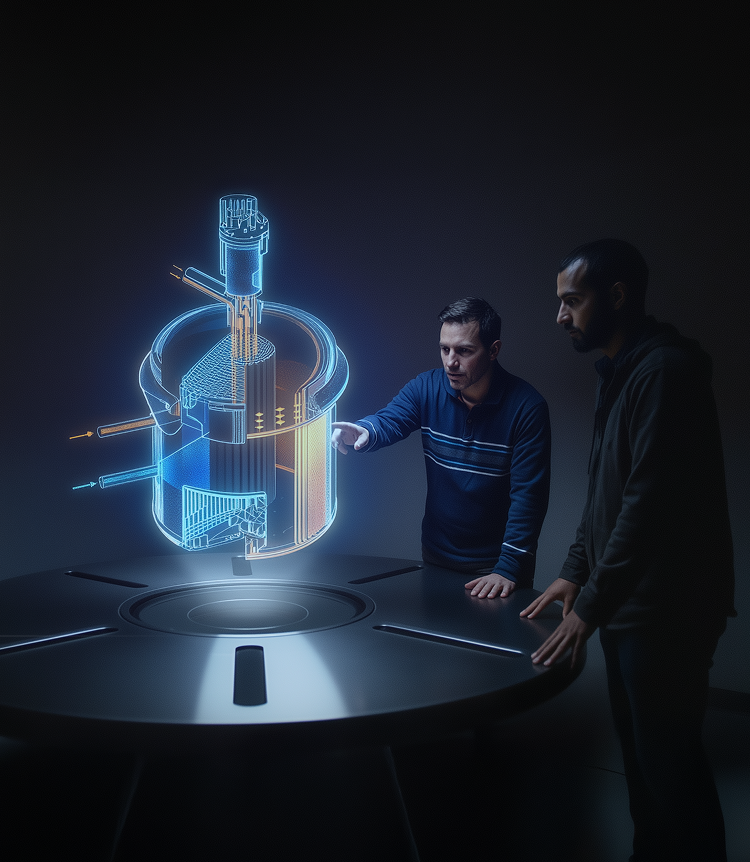
Blue-lit futuristic cylindrical structure with technical blueprint overlays on black background.

Our plan to develop nuclear intelligence

A phased development plan for the future outlining our research, validation, and deployment over a 20-year horizon.
Current Phase
Simulation, training, and modeling of real-world nuclear environments.
know more
Man wearing virtual reality headset with holographic blueprint of industrial cooling towers in front.
Current Phase
Simulation, training, and modeling of real-world nuclear environments.
know more
We begin with digital twins and immersive training — creating a virtual nuclear ecosystem where ideas can be tested, stressed, and perfected.
Phase two
Continuous refinement of systems through iterations and learning
know more
Operator training interface asking about the Reactor Protection System (RPS) trip button, alongside a schematic control panel layout with highlighted sections and a blue-toned image of reactor components.
Phase two
Continuous refinement of systems through iterations and learning
AI copilots and continuous simulation data drive systematic improvements — refining designs, enhancing operating procedures, and reducing uncertainty at every layer of the system.
Phase three
Translating nuclear intelligence into a safe, reliable operating reactors
know more
Blue-lit futuristic cylindrical structure with technical blueprint overlays on black background.
Phase three
Translating nuclear intelligence into a safe, reliable operating reactors
With validated digital models, evolved designs, and an AI-enhanced workforce, the final step is to design, construct, and operate modular nuclear reactors engineered for safety, efficiency,  and scalability.

Our products power the future of nuclear intelligence.

AnushaktiAI interface showing a question about the annual radiation dose limit for the public according to AERB and the answer stating a 1 mSv per year effective dose limit.
Person wearing glasses viewing a technical schematic with 3D model and engineering diagrams on a computer screen.
Digital control panel of a nuclear plant showing reactor status as dormant, reactor load at 1%, contamination at 99.993%, pressure at 3739.4 PSI, temperature 195.5°C, flow rate 939.4 L/s, and radiation at 0.25 µSV/H.
3D illustration of an industrial power plant with cooling towers and multiple smokestacks emitting steam.

AnuShaktiAI

AnuShaktiAI

AnushaktiAI interface showing a question about the annual radiation dose limit for the public according to AERB and the answer stating a 1 mSv per year effective dose limit.

A regulatory-aware AI copilot for the nuclear ecosystem.

Instant access to AERB codes, safety guidelines, and technical knowledge—enabling informed, compliant decisions for regulators, operators, engineers, radiation users, and citizens.

A regulatory-aware AI copilot for the nuclear ecosystem.

Instant access to AERB codes, safety guidelines, and technical knowledge—enabling informed, compliant decisions for regulators, operators, engineers, radiation users, and citizens.

VR training

VR training

Person wearing glasses viewing a technical schematic with 3D model and engineering diagrams on a computer screen.

A hyper-realistic virtual control room for nuclear operations training.

AI copilots guide teams through routine operations, transients, and emergencies with real-time feedback—reinforcing best practices and nuclear-grade readiness.

A hyper-realistic virtual control room for nuclear operations training.

AI copilots guide teams through routine operations, transients, and emergencies with real-time feedback—reinforcing best practices and nuclear-grade readiness.

Digital twin platform

Digital twin platform

Digital control panel of a nuclear plant showing reactor status as dormant, reactor load at 1%, contamination at 99.993%, pressure at 3739.4 PSI, temperature 195.5°C, flow rate 939.4 L/s, and radiation at 0.25 µSV/H.

A full-spectrum digital twin and simulation environment for nuclear power plants.

AI-driven analytics deliver operational visibility, predictive failure insights, and system-level optimisation—improving safety, stability, and efficiency.

A full-spectrum digital twin and simulation environment for nuclear power plants.

AI-driven analytics deliver operational visibility, predictive failure insights, and system-level optimisation—improving safety, stability, and efficiency.

Next-generation reactors

Next-generation reactors

3D illustration of an industrial power plant with cooling towers and multiple smokestacks emitting steam.

An AI-driven approach to advancing nuclear fission reactor design. AI-optimised design,

digital-twin validation, and generative engineering enable higher passive safety, improved thermal efficiency, and long-term reliability for clean, high-performance nuclear power.

An AI-driven approach to advancing nuclear fission reactor design. AI-optimised design,

digital-twin validation, and generative engineering enable higher passive safety, improved thermal efficiency, and long-term reliability for clean, high-performance nuclear power.

We help to build clean, safe, and reliable nuclear energy systems the world can trust.

Learn More About Us
Blue abstract interconnected circular shapes forming a cluster on a transparent background.

Frequently asked questions

Can’t find what you’re looking for? Reach out and we’ll get back to you.

1. How does the VR Operator Copilot improve training?

Our VR-based training system places operators inside a realistic 3D control room where they can practice scenarios, experience accident conditions visually, and ask unlimited natural-language questions about operations, systems, and reactor physics. This leads to faster learning and stronger nuclear-grade competency.

2. What is a Digital Twin in the nuclear context?

A digital twin is a high-fidelity, physics-based 3D model of a nuclear plant that reflects real-time data, system interactions, and transient behavior. Operators can visualize what is happening inside the plant, simulate “what-if” events, perform virtual inspections, and receive early predictive alerts for maintenance and safety.

3. How will AI help design safer and more efficient reactors?

AI enables generative design, rapid simulation of millions of design variations, predictive modeling, and intelligent optimization of reactor geometry, cooling systems, and safety features. Combined with high-fidelity digital twins, this approach supports the development of next-generation fission reactors with improved safety margins and higher efficiency.

4. Do you collaborate with utilities, research institutes, or regulators?

We are open to collaboration across utilities, training institutes, academia, and regulatory organizations. Our goal is to strengthen nuclear safety and operational excellence through advanced technology.

5. How can we request a demo or explore partnership opportunities?

You can reach out through the contact form on our website or send us an email at info@polyenergetics.com. Our team will schedule a detailed walkthrough tailored to your facility’s needs.